Quality is built before the finish goes on
The production task is to reproduce intended behaviour consistently—not merely to reproduce a recognisable shape.
Two frames can look alike while differing in material specification, joint preparation, dimensional control or assembly history. Two mats can share an external thickness yet use different foam systems and internal construction. Appearance is useful for identifying obvious damage, but it is not a complete account of how equipment was made.
For buyers and students, the practical aim is to understand which production controls support the apparatus function, and which records connect the delivered item to its design and service instructions.
Production file / 02A
Metalwork: control the hidden variables
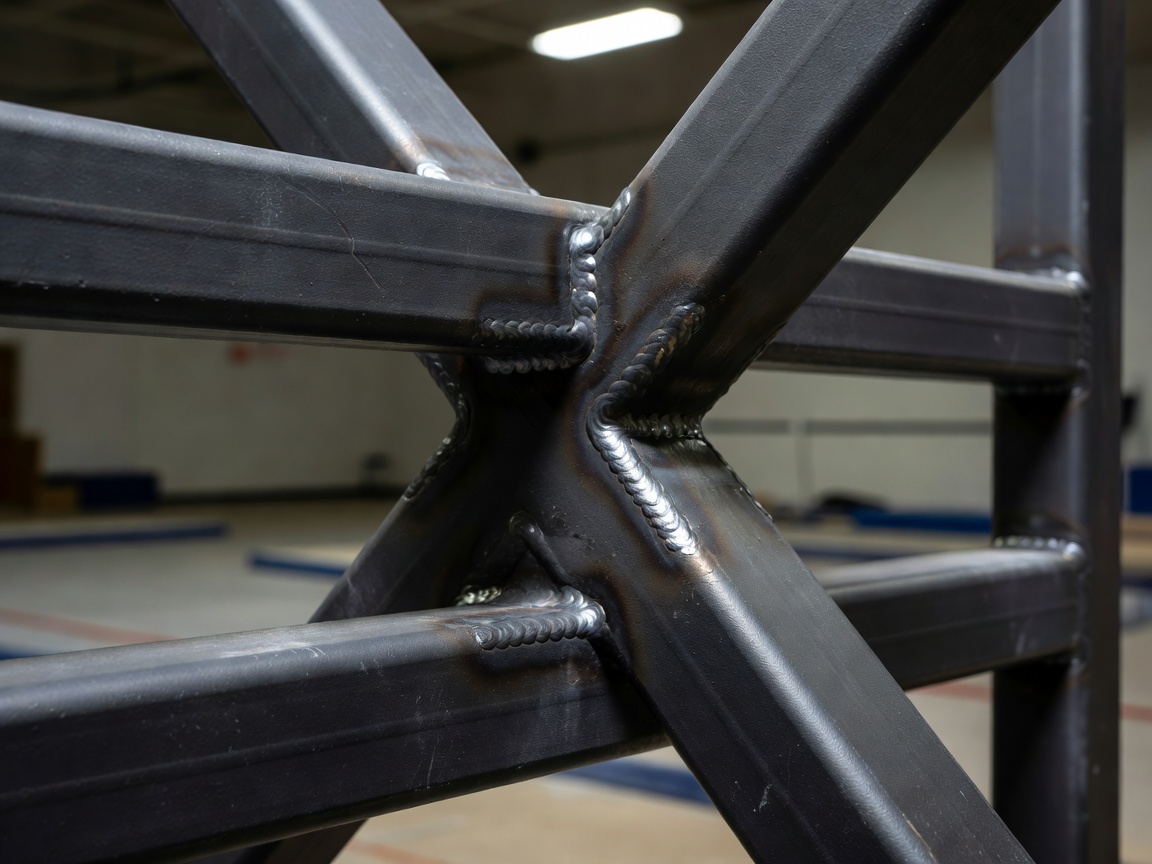
Frame production begins with specified material and geometry. Cutting, bending, machining and welding can each influence the final assembly. A controlled process checks that components are suitable before errors become difficult to detect beneath a coating or inside a completed mechanism.
Weld appearance alone does not establish joint quality. Appropriate preparation, process selection, personnel competence and inspection depend on the design and manufacturing requirements. Equally, a protective coating has a defined role: it can support durability, but it does not compensate for unsuitable material or a poorly formed joint.
Dimensional control matters at the assembly level. A small mismatch at an adjustment interface may affect engagement, alignment or ease of operation. The relevant question is whether the finished item meets its specified tolerances and functions as intended, not whether a worker can force the parts together.
Production file / 02B
Timber and composites: material systems
Apparatus rails and contact components may use timber, engineered wood or fibre-reinforced constructions, depending on the product. Their response depends on the complete material system, including fibre orientation, bonding, geometry and surface treatment where applicable.
Natural variability, moisture conditions and adhesive processing can be important manufacturing considerations. Composite construction likewise needs control over constituent materials and processing conditions. A generic material label such as “wood” or “fibreglass” says too little to predict the behaviour of the finished component.
Surface condition also links manufacture to use. An intended grip surface should not be confused with permission to sand, coat or chemically treat a rail. Such interventions can alter dimensions, grip or material integrity. Follow the manufacturer’s care instructions and obtain guidance before modifying a contact surface.
Production file / 02C
Padding is an assembly, not a thickness
A landing mat may combine layers with different mechanical responses, a cover, seams, fasteners and connection features. Those elements work together. Foam density and total thickness are useful descriptors, but neither alone establishes impact performance or suitability for a particular activity.
Production must preserve the intended layer arrangement and dimensions. Cover construction also matters: seam placement, closure details and the fit around the core can affect surface continuity and long-term durability. Where mats join, the specified connection system helps maintain the intended arrangement during use.
A replacement cover or foam insert should therefore be treated as a compatibility question. A locally made substitute may change friction, fit, ventilation or deformation. Ask the manufacturer which replacement parts are appropriate rather than assuming that an externally similar component preserves the original performance.
Production file / 02D
Traceability connects the workshop to the hall
Identification links the item in service to its documentation. Depending on the equipment, a product label, model reference, serial number or batch identifier may support that link. Retain the information in a facility register before labels become worn or difficult to access.
Useful production records may include material references, inspection results, assembly checks and controlled changes. A buyer does not necessarily receive every internal record, but should be able to identify the product, obtain the applicable instructions and understand the evidence supplied with it.
Quality-management certification has a different scope from product conformity. ISO 9001 concerns a quality management system; it does not, by itself, demonstrate that a particular beam, bar or mat meets every applicable requirement. Ask what was assessed and avoid treating a management-system statement as an apparatus test result.
Compare the question, not the marketing adjective
| Claim or feature | Useful follow-up | What it cannot establish alone |
|---|---|---|
| Robust steel frame | What design and production controls support the intended use? | Installed stability or connection integrity |
| Layered landing mat | Which complete assembly and use conditions does the evidence cover? | Suitability based only on thickness |
| Traceable product | Which identifier links this item to instructions and service information? | Its present condition after years of use |
Request clear product identification, an agreed configuration, assembly and care instructions, and relevant verification documentation. A responsible supplier should distinguish these documents rather than presenting one as a substitute for all the others.
Manufacturers such as GYMNOVA, SPIETH Gymnastics and Janssen-Fritsen publish product-specific information. Their names here are examples of sources to consult, not endorsements or claims that their products are interchangeable. Always use the documentation for the actual item and revision concerned.